GPU Product
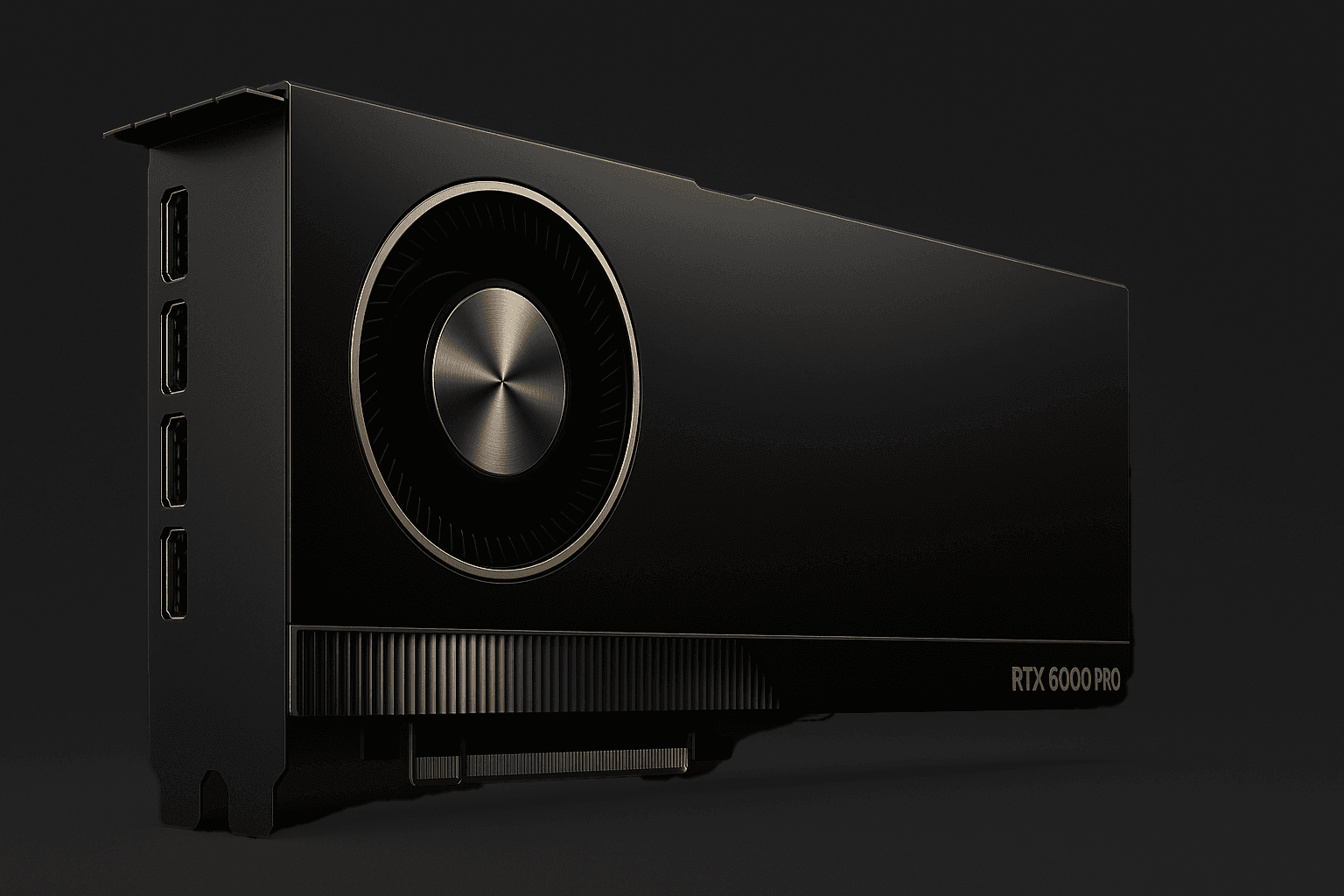
Rent NVIDIA RTX PRO 6000 GPUs
96 GB VRAM for Enterprise-Scale AI & ML Workloads
Technical Specifications
RTX PRO 6000 Rental Options
Rent RTX PRO 6000 GPUs on-demand with flexible pricing. Get 96 GB of VRAM for your largest AI workloads without upfront hardware costs.
Comparison
RTX PRO 6000 vs RTX 5090
| RTX PRO 6000 | RTX 5090 | % Diff | |
|---|---|---|---|
| Architecture | Blackwell | Blackwell | N/A |
| Process Tech | TSMC 4 nm | TSMC 4 nm | N/A |
| Transistors | ≈110 B | 92.2 B | +19.3% |
| Compute Units (SMs) | 188 | 170 | +10.6% |
| Shaders (CUDA) | 24 064 | 21 760 | +10.6% |
| Tensor Cores | 752 | 680 | +10.6% |
| RT Cores | 188 | 170 | +10.6% |
| ROPs | 216 | 192 | +12.5% |
| TMUs | 752 | 680 | +10.6% |
| Boost Clock | 2 617 MHz | 2 407 MHz | +4.35% |
| Memory Type | GDDR7 ECC | GDDR7 | N/A |
| VRAM | 96 GB | 32 GB | +200% |
| Bus Width | 512-bit | 512-bit | 0% |
| VRAM Speed | 28 Gbps | 28 Gbps | 0% |
| Bandwidth | 1 792 GB/s | 1 790 GB/s | +0.1% |
| TDP | 600 W | 575 W | +4.35% |
| PCIe | PCIe 5.0 ×16 | PCIe 5.0 ×16 | N/A |
Datacenter Comparison
RTX PRO 6000 Blackwell vs NVIDIA H100 vs H200
Choosing between the RTX PRO 6000 Blackwell and NVIDIA's Hopper datacenter GPUs depends on your workload. In an RTX PRO 6000 vs H100 comparison, the Blackwell card pulls ahead on raw compute density and offers more VRAM (96 GB vs 80 GB) at a meaningfully lower hourly cost. In an RTX PRO 6000 vs H200 comparison, the H200 keeps the lead on memory capacity (141 GB) and bandwidth (4.8 TB/s) for the largest models, but the PRO 6000 is significantly cheaper to run and uses newer 5th-generation Blackwell tensor cores.
| RTX PRO 6000 | H100 SXM5 | H200 SXM | |
|---|---|---|---|
| Architecture | Blackwell | Hopper | Hopper |
| Process Tech | TSMC 4 nm | TSMC 4N | TSMC 4N |
| Transistors | ≈110 B | 80 B | 80 B |
| Compute Units (SMs) | 188 | 132 | 132 |
| Shaders (CUDA) | 24 064 | 16 896 | 16 896 |
| Tensor Cores | 752 (5th gen) | 528 (4th gen) | 528 (4th gen) |
| Boost Clock | 2 617 MHz | ~1 980 MHz | ~1 980 MHz |
| Memory Type | GDDR7 ECC | HBM3 | HBM3e |
| VRAM | 96 GB | 80 GB | 141 GB |
| Bandwidth | 1 792 GB/s | 3 350 GB/s | 4 800 GB/s |
| TDP | 600 W | 700 W | 700 W |
| PCIe | PCIe 5.0 ×16 | PCIe 5.0 ×16 | PCIe 5.0 ×16 |
| Form Factor | Workstation/Server | SXM5 | SXM5 |
When the RTX PRO 6000 Wins
Multi-tenant inference, fine-tuning models up to ~100B parameters, generative AI rendering, and cost-sensitive enterprise deployments where Blackwell efficiency and 96 GB of VRAM matter more than peak HBM bandwidth.
When the H100 or H200 Wins
Frontier-scale training (200B+ parameters), workloads bottlenecked by memory bandwidth such as large MoE models or very long-context inference, and multi-node deployments that depend on NVLink fabric.
For full RTX PRO 6000 Blackwell benchmarks across LLM inference workloads, see our GPU benchmarks hub.
Performance
Performance Metrics
Massive GPU Memory
96 GB of GDDR7 lets you fit multi-billion-parameter LLMs and complex 3D scenes on a single card.
Blackwell AI Engines
Fifth-gen Tensor and fourth-gen RT cores deliver >125 TFLOPS FP32 and up to 4 000 AI TOPS.
PCIe 5.0 Throughput
Double host-to-GPU bandwidth vs PCIe 4.0, eliminating data-transfer bottlenecks in large-scale workloads.
Use Cases
Ideal Use Cases
Ultra-Large LLMs
Train or serve 70–175 B-parameter language models without multi-GPU partitioning.
Generative XR
Real-time ray tracing and neural render pipelines for AR/VR experiences.
AI-Driven Media
Video upscaling, diffusion, and texture synthesis at production scale.
HPC Simulation
Accelerate molecular dynamics, CFD, and large-graph analytics workloads.
RTX PRO 6000 FAQ
Common Questions About the RTX PRO 6000
Ready to get started?
Get in touch with our team to discuss your requirements and find the right solution for your infrastructure.