| Title | Tutorial: Script Objects in SQL Server Management Studio | ||||||||
|---|---|---|---|---|---|---|---|---|---|
| description | A Tutorial for scripting out objects in SSMS. | ||||||||
| keywords | SQL Server, SSMS, SQL Server Management Studio, Scripts, Scripting | ||||||||
| author | MashaMSFT | ||||||||
| ms.author | mathoma | ||||||||
| ms.date | 03/13/2018 | ||||||||
| ms.topic | Tutorial | ||||||||
| ms.suite | sql | ||||||||
| ms.prod_service | sql-tools | ||||||||
| ms.reviewer | sstein | ||||||||
| manager | craigg | ||||||||
| helpviewer_keywords |
|
This tutorial will teach you how to generate Transact-SQL (T-SQL) scripts for various objects found within SQL Server Management Studio. In this tutorial, you will find examples of how to script the following objects:
[!div class="checklist"]
- Queries when performing actions within the GUI
- Databases in two different ways ("Script As" and "Generate Script")
- Tables
- Stored procedures
- Extended events
The summary of this tutorial is that any object in Object Explorer can be scripted by right-clicking it and selecting the Script Object As option.
To complete this Tutorial, you need SQL Server Management Studio, access to a SQL Server, and an AdventureWorks database.
- Install SQL Server Management Studio.
- Install SQL Server 2017 Developer Edition.
- Download AdventureWorks2016 Sample Databases. Instructions for restoring databases in SSMS can be found here: Restoring a Database.
Any time you perform a task using the GUI in SSMS, you can also generate the T-SQL code associated with that task. The following examples show how to do so when taking a backup of a database, and when you shrink the transaction log. These same steps can be applied to any action that's completed via the GUI.
-
Connect to your SQL Server.
-
Expand the Databases node.
-
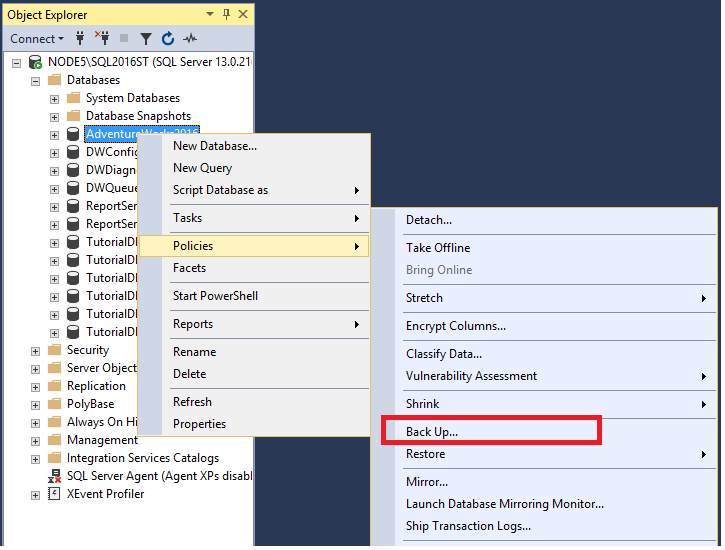
Right-click the Adventureworks2016 database > Tasks > Back up:
-
Configure the backup the way you want. For the purpose of this Tutorial, everything is left at default. However, any changes made in the window will also be reflected in the script.
-
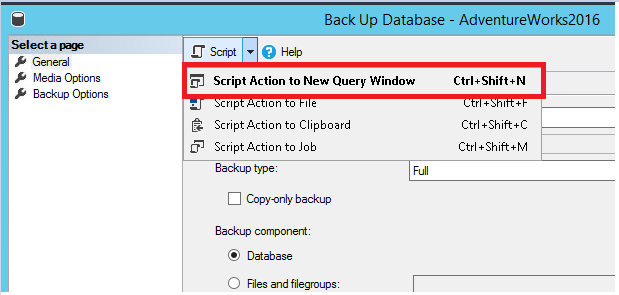
Select the option to Script > Script Action to Query Window:
-
Review the T-SQL populated in the query window:

-
Select Execute to execute the query to backup the database via T-SQL.


-
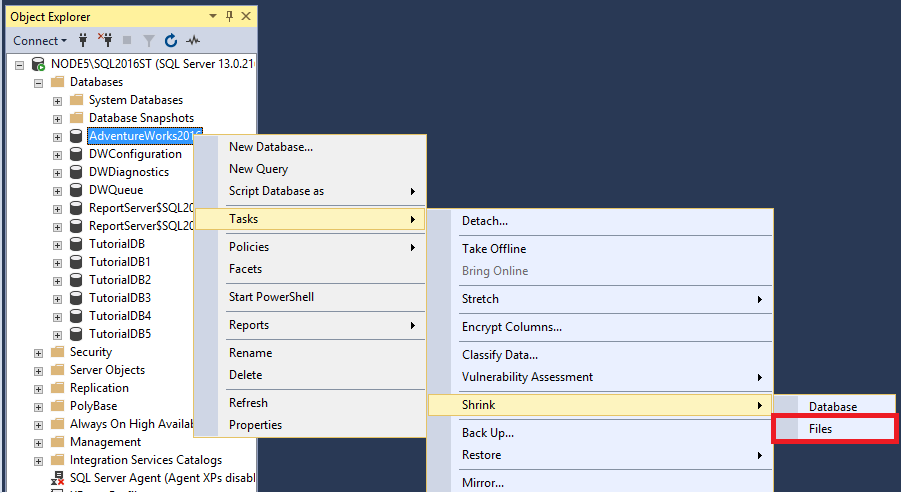
Right-click the AdventureWorks2016 database > Tasks > Shrink > Files:
-
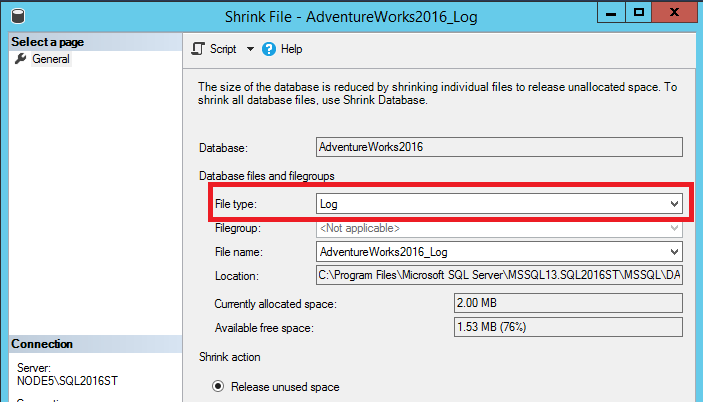
Select Log from the File Type drop down:
-
Select the option Script and Script Action to Clipboard:
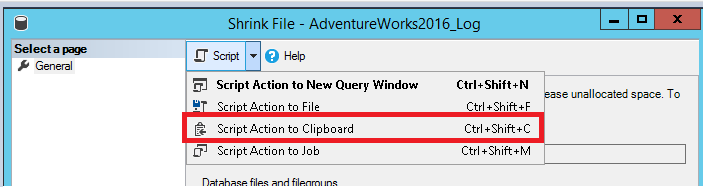
-
Open a New Query window and paste (Right-click in the window > Paste):
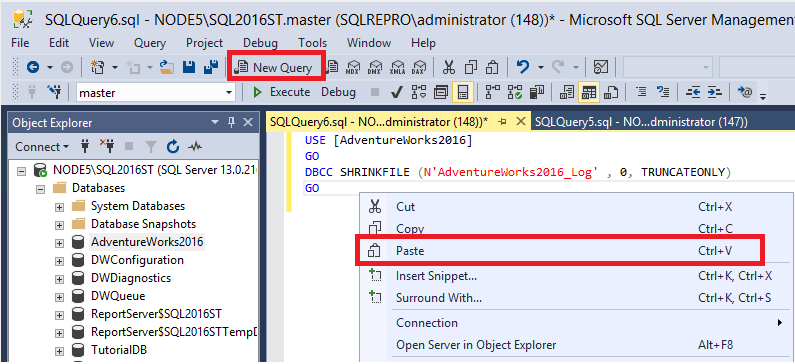
-
Select Execute to execute the query and shrink the transaction log.


The following section teaches you how to script out the database, both using the Script As option and the Generate Scripts option. The Script As option will recreate the database and the configuration options for it. The Generate Scripts option will allow you to script both the schema and the data. In this section, you will create two new databases, AdventureWorks2016a will be created using the Script As option. AdventureWorks2016b will be created using the Generate Scripts option.
-
Connect to your SQL Server.
-
Expand the Databases node.
-
Right-click the AdventureWorks2016 database > Script Database As > Create To > New Query Window:
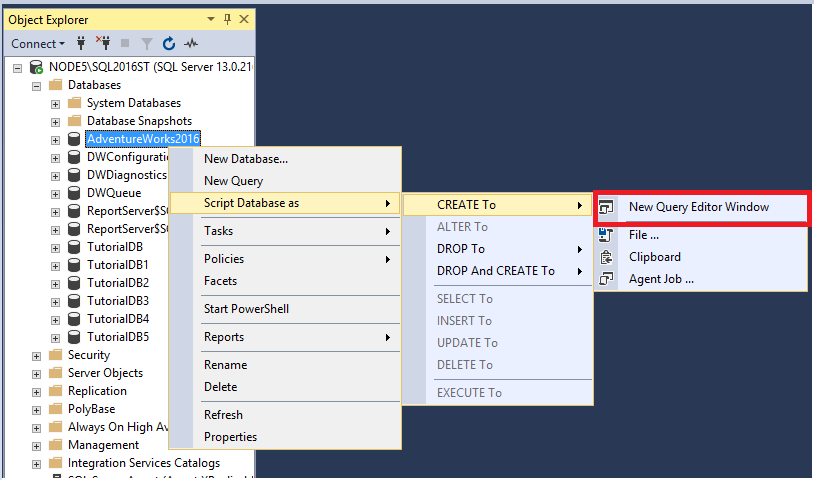
-
Review the database creation query in the window:
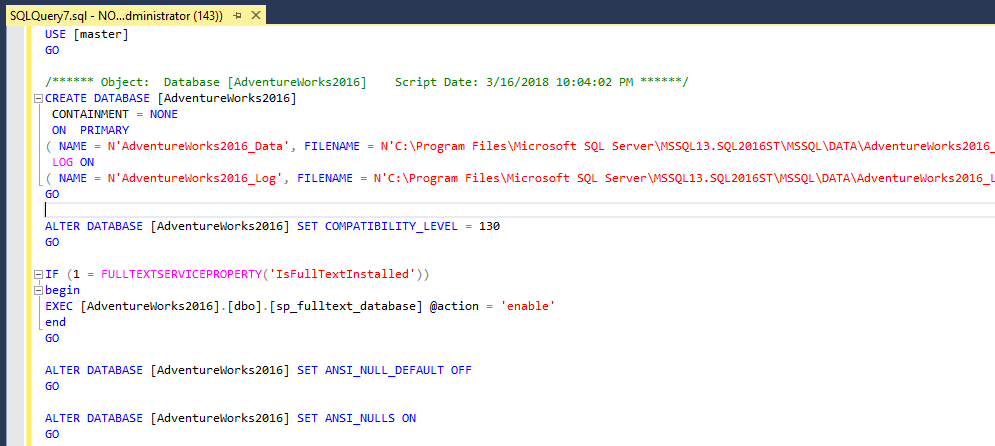
- This option will only script out the database configuration options.
-
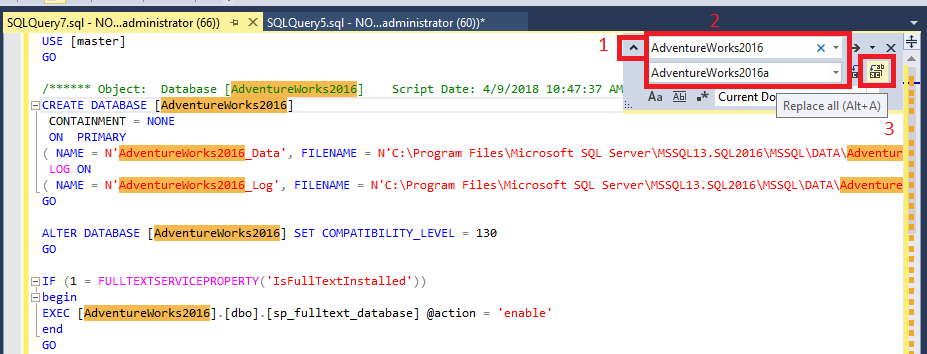
On your keyboard, select Ctrl + F to open the Find dialog box and select the down arrow to open the Replace option. On the top Find line, type in AdventureWorks2016 and on the bottom Replace line, type in AdventureWorks2016a.
-
Select Replace All to replace all instances of AdventureWorks2016 with AdventureWorks2016a.
-
Select Execute to execute the query and create your new AdventureWorks2016a database.


-
Connect to your SQL Server.
-
Expand the Databases node.
-
Right-click the AdventureWorks2016 database > Tasks > Generate Scripts:

-
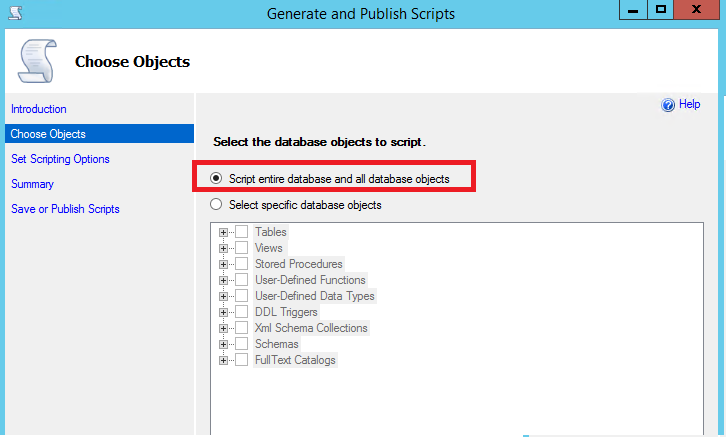
The Introduction page opens, select Next to open Chose Objects page. You have the option to select the entire database or specific objects in the database. Select the option to Script entire database and all database objects
-
Select Next to open the Set Scripting Options page, which is where you can configure where to save the script as well as some additional advanced options.
a. Select the option to Save to new query Window.
b. Select Advanced and ensure these options are set:
- Script Statistics set to Script Statistics
- Types of data to script set to Schema only
- Script Indexes set to true
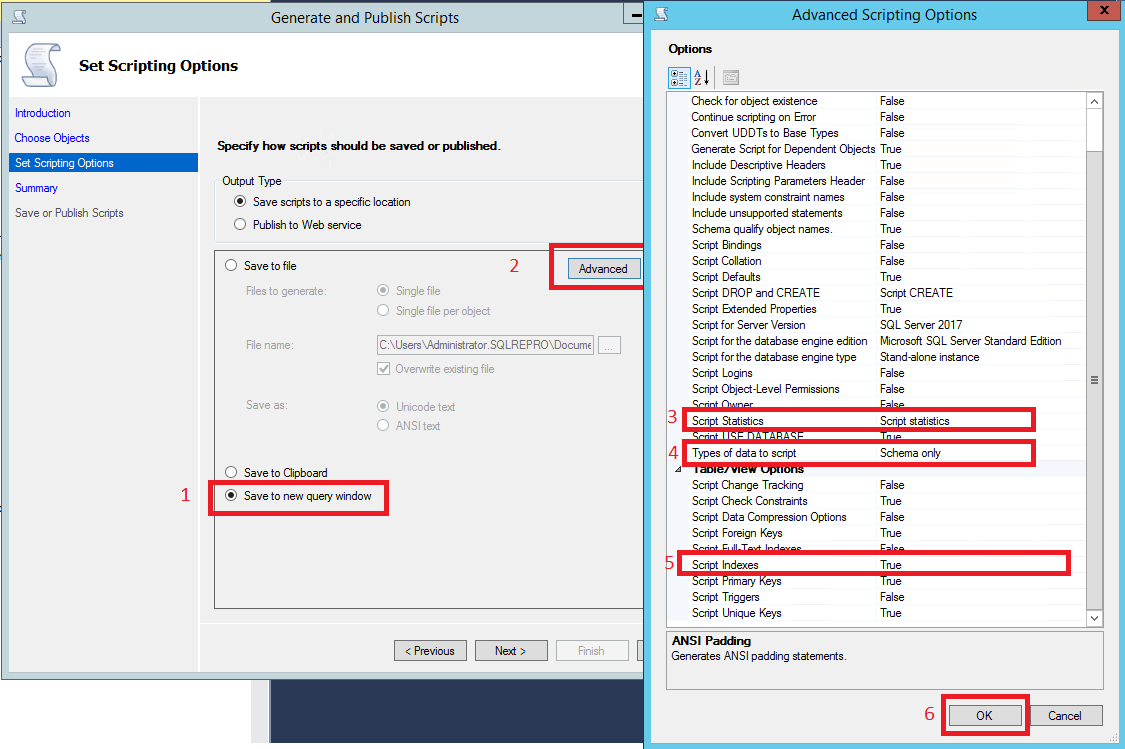
[!NOTE] You have the ability to script the data for the database when you select Schema and data for the Types of data to script option. However, this is not ideal with large databases as it can take more memory than SSMS is able to allocate. This is okay for small databases, but if you want to move data for a larger database, you should use the Import and Export Wizard.
-
Select OK and then select Next.
-
Select Next on the Summary and then select Next again to generate the script to a New Query Window.
-
On your keyboard, select Ctrl + F to open the Find dialog box and select the down arrow to open the Replace option. On the top Find line, type in AdventureWorks2016 and on the bottom Replace line, type in AdventureWorks2016b. a. Select Replace All to replace all instances of AdventureWorks2016 with AdventureWorks2016b.

-
Select Execute to execute the query and create your new AdventureWorks2016b database.


This section covers how to script out tables from your database. Using this option, you can either create the table, or drop and create the table. You can also use this option to script the T-SQL associated with modifying the table, such as to insert into it, or update to it. In this section, you will drop a table, and then recreate it.
-
Connect to your SQL Server.
-
Expand your Databases node.
-
Expand your AdventureWorks database node.
-
Expand your Tables node.
-
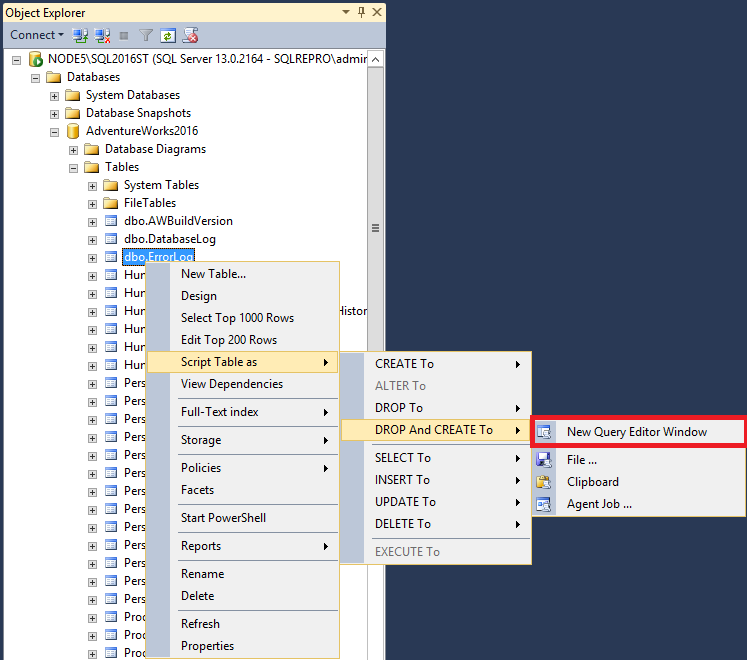
Right-click the dbo.ErrorLog > Script Table as > Drop and Create To > New Query Editor Window:
-
Select Execute to execute the query - this will drop the Errorlog table and recreate it.
[!NOTE] The Errorlog table is empty by default in the AdventureWorks2016 database, so you're not losing any data by dropping the table. However, following these steps on a table with data will cause data loss.

In this section, you will learn how to drop and create a stored procedure.
-
Connect to your SQL Server.
-
Expand your Databases node.
-
Expand your Programmability node.
-
Expand your Stored Procedure node.
-
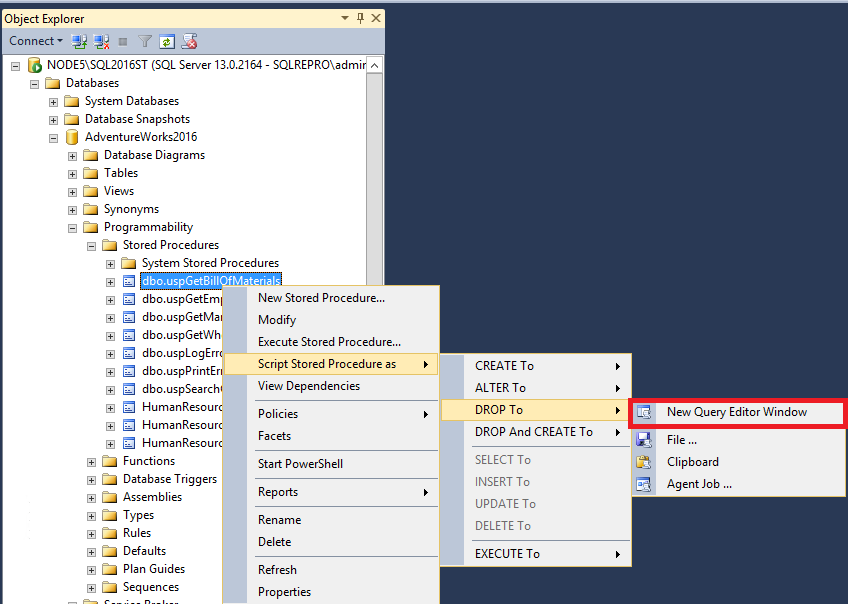
Right-click the stored procedure dbo.uspGetBillOfMaterials> Script Stored Procedure As > Drop and Create to > New Query Window:

This section covers how to script out extended events.
-
Connect to your SQL Server.
-
Expand your Management node.
-
Expand your Extended Events node.
-
Expand your Sessions node.
-
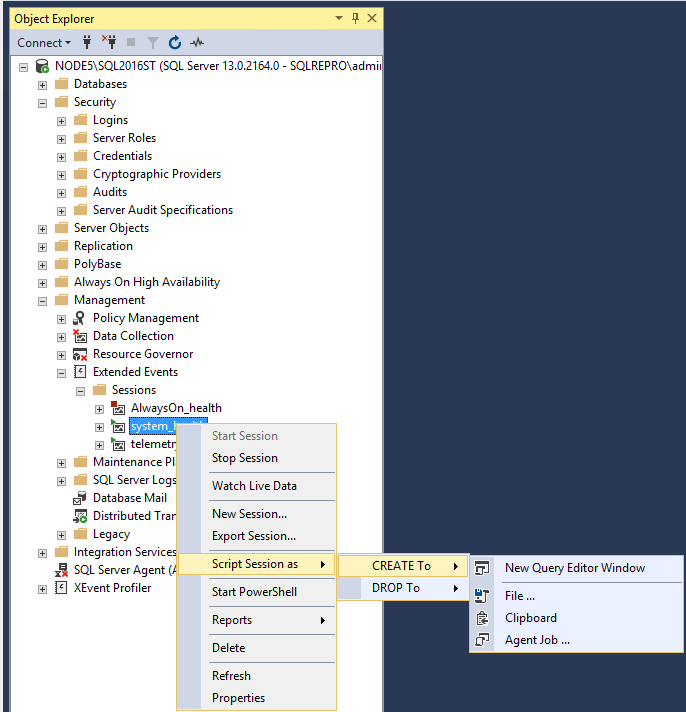
Right-click the extended session you're interested in > Script Session As > New Query Editor Window:
-
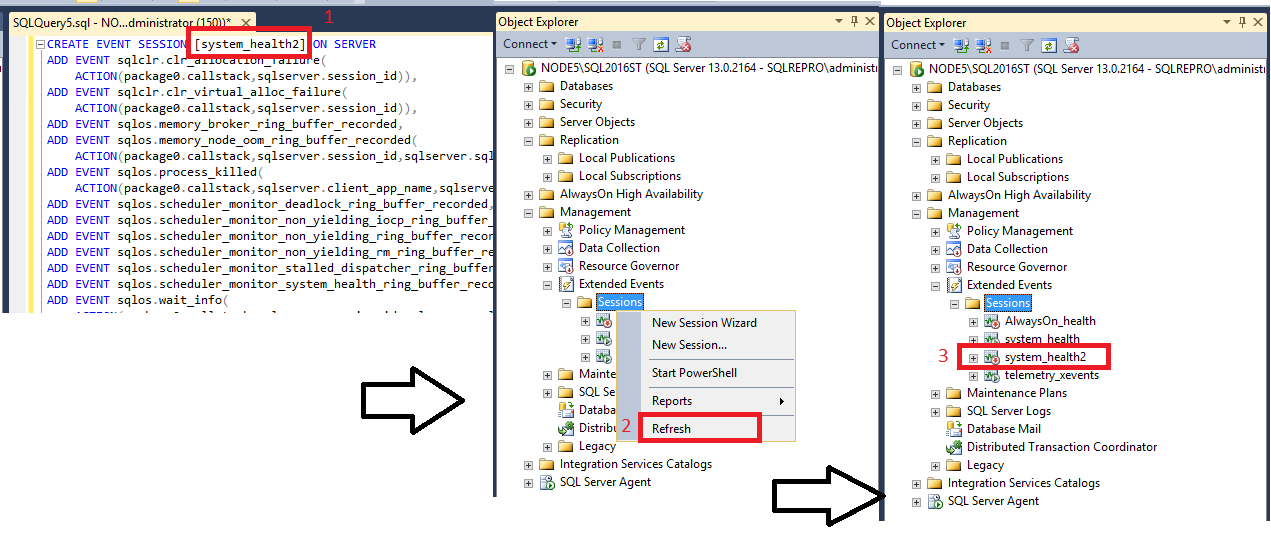
In the New Query Window, modify the new name of the session from system_health to system_health2 and select Execute to execute the query.
a. Right-click Sessions in Object Explorer and select Refresh to see your new Extended Event Session. The green icon next to the session indicates the session is running whereas the red icon indicates the session is stopped.
[!NOTE] You can start the session by right-clicking it and selecting Start. However, since this is a copy of the already-running system_health session, this step can be skipped. You can delete the copy of the extended event session by right-clicking it and selecting Delete.


The next article introduces you to the pre-built T-SQL templates found within SSMS.
Advance to the next article to learn more:
[!div class="nextstepaction"] Next steps