| title | Tips and tricks using SSMS | ||||||||
|---|---|---|---|---|---|---|---|---|---|
| description | Learn to comment & uncomment code, indent text, filter objects, access error logs, & find SQL Server instance names with SQL Server Management Studio. | ||||||||
| ms.prod | sql | ||||||||
| ms.technology | ssms | ||||||||
| ms.prod_service | sql-tools | ||||||||
| ms.topic | tutorial | ||||||||
| author | markingmyname | ||||||||
| ms.author | maghan | ||||||||
| ms.reviewer | |||||||||
| helpviewer_keywords |
|
||||||||
| ms.custom | seo-lt-2019 | ||||||||
| ms.date | 03/13/2018 |
This article gives you some tips and tricks for using SQL Server Management Studio (SSMS). This article shows you how to:
[!div class="checklist"]
- Comment/uncomment your Transact-SQL (T-SQL) text
- Indent your text
- Filter objects in Object Explorer
- Access your [!INCLUDEssNoVersion] error log
- Find the name of your [!INCLUDEssNoVersion] instance
To test out the steps provided in this article, you need SQL Server Management Studio, access to a SQL server, and an AdventureWorks database.
- Install SQL Server Management Studio.
- Install [[!INCLUDEssnoversion] Developer Edition](https://www.microsoft.com/sql-server/sql-server-downloads).
- Download an AdventureWorks sample database. To learn how to restore a database in SSMS, see Restoring a database.
You can comment and uncomment portions of your text by using the Comment button on the toolbar. Text that is commented out is not executed.
-
Open SQL Server Management Studio.
-
Connect to your SQL server.
-
Open a New Query window.
-
Paste the following [!INCLUDEtsql] code in your text window.
USE master GO -- Drop the database if it already exists IF EXISTS ( SELECT name FROM sys.databases WHERE name = N'TutorialDB' ) DROP DATABASE TutorialDB GO CREATE DATABASE TutorialDB GO ALTER DATABASE [TutorialDB] SET QUERY_STORE=ON GO -
Highlight the Alter Database portion of the text, and then select the Comment button on the toolbar:

-
Select Execute to run the uncommented portion of the text.
-
Highlight everything except for the Alter Database command, and then select the Comment button:

[!NOTE] The keyboard shortcut to comment text is CTRL + K, CTRL + C.
-
Highlight the Alter Database portion of the text, and then select the Uncomment button to uncomment it:

[!NOTE] The keyboard shortcut to uncomment text is CTRL + K, CTRL + U.
-
Select Execute to run the uncommented portion of the text.


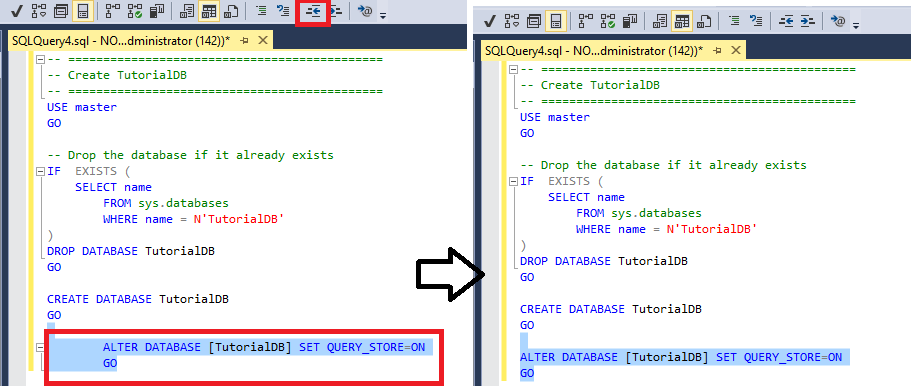
You can use the indentation buttons on the toolbar to increase or decrease the indent of your text.
-
Open a New Query window.
-
Paste the following [!INCLUDEtsql] code in your text window:
USE master
  GO

  --Drop the database if it already exists
  IF  EXISTS (
	    SELECT name
		    FROM sys.databases
		    WHERE name = N'TutorialDB'
          )

  DROP DATABASE TutorialDB
  GO

  CREATE DATABASE TutorialDB
  GO

  ALTER DATABASE [TutorialDB] SET QUERY_STORE=ON
  GO
-
Highlight the Alter Database portion of the text, and then select the Increase Indent button on the toolbar to move this text forward:

-
Highlight the Alter Database portion of the text again, and then select the Decrease Indent button to move this text back.


In databases that have many objects, you can use filtering to search for specific tables, views, etc. This section describes how to filter tables, but you can use the following steps in any other node in Object Explorer:
-
Connect to your SQL server.
-
Expand Databases > AdventureWorks > Tables. All the tables in the database appear.
-
Right-click Tables, and then select Filter > Filter Settings:

-
In the Filter Settings window, you can modify some of the following filter settings:
-
Filter by name:

-
Filter by schema:

-
-
To clear the filter, right-click Tables, and then select Remove Filter.


The error log is a file that contains details about things that occur in your [!INCLUDEssNoVersion] instance. You can browse and query the error login SSMS. The error log is a .log file that's located on your disk.
-
Connect to your [!INCLUDEssNoVersion].
-
Expand Management > SQL Server Logs.
-
Right-click the Current error log, and then select View SQL Server Log:


-
Connect to your SQL server.
-
Open a New Query window.
-
Paste the following [!INCLUDEtsql] code in your query window:
sp_readerrorlog 0,1,'Server process ID'
-
Modify the text in the single quotes to text you want to search for.
-
Execute the query, and then review the results:


-
Connect to your [!INCLUDEssNoVersion].
-
Open a New Query window.
-
Paste the following [!INCLUDEtsql] code in your query window, and then select Execute:
SELECT SERVERPROPERTY('ErrorLogFileName') AS 'Error log file location'
-
The results show the location of the error log in the file system:


The path for your [!INCLUDEssNoVersion] error log can vary depending on your configuration settings. The path for the error log location can be found in the startup parameters within the SQL Server Configuration Manager. Follow the steps below to locate the relevant startup parameter identifying the location of your [!INCLUDEssNoVersion] error log. Your path may vary from the path indicated below.
-
Open SQL Server Configuration Manager.
-
Expand Services.
-
Right-click your [!INCLUDEssNoVersion] instance, and then select Properties:

-
Select the Startup Parameters tab.
-
In the Existing Parameters area, the path after "-e" is the location of the error log:

There are several error log files in this location. The file name that ends with *.log is the current error log file. File names that end with numbers are previous log files. A new log is created every time the SQL server restarts.
-
Open the errorlog.log file in Notepad.


You have a few options for finding the name of your SQL server before and after you connect to [!INCLUDEssNoVersion].
-
Follow the steps to locate the SQL Server error log on disk. Your path may vary from the path in the image below.
-
Open the errorlog.log file in Notepad.
-
Search for the text Server name is.
Whatever is listed in the single quotes is the name of the [!INCLUDEssNoVersion] instance that you'll be connecting to:

The format of the name is HOSTNAME\INSTANCENAME. If you see only the host name, then you've installed the default instance and your instance name is MSSQLSERVER. When you connect to a default instance, the host name is all you need to enter to connect to your SQL server.

When you're connected to [!INCLUDEssNoVersion], you can find the server name in three locations:
-
The name of the server is listed in Object Explorer:

-
The name of the server is listed in the Query window:

-
The name of the server is listed in Properties.
-
In the View menu, select Properties Window:

-


If you're connected to an alias or to an Availability Group listener, that information appears in Object Explorer and Properties. In this case, the [!INCLUDEssNoVersion] name might not be readily apparent, and must be queried:
-
Connect to your SQL server.
-
Open a New Query window.
-
Paste the following [!INCLUDEtsql] code in the window:
select @@Servername -
View the results of the query to identify the name of the [!INCLUDEssNoVersion] instance you're connected to:


The best way to get acquainted with SSMS is through hands-on practice. These tutorial and how-to articles help you with various features available within SSMS. These articles teach you how to manage the components of SSMS and how to find the features that you use regularly.