| title | Use Visual Studio Code with SQL Server on Linux | SQL Server vNext CTP1 |
|---|---|
| description | |
| author | erickangMSFT |
| ms.author | erickang |
| manager | jhubbard |
| ms.date | 11/10/2016 |
| ms.topic | article |
| ms.prod | sql-linux |
| ms.technology | database-engine |
| ms.assetid | 9766ee75-32d3-4045-82a6-4c7968bdbaa6 |
This topic shows how to use mssql for Visual Studio Code (VS Code) to develop SQL Server vNext CTP1 databases on Linux.
Visual Studio Code is a graphical code editor for Linux, MAC OS and Windows that supports extensions. The mssql extension for VS Code enables you to connect to SQL Server, query using Transact-SQL and view the results.
In this tutorial, we will walk you through how to:
-
Install VS Code and the mssql extension
-
Connect to SQL Server vNext CTP1 on Linux.
-
Easily write T-SQL scripts with IntelliSense, TSQL snippets, syntax colorization and real-time error validation.
-
Execute the scripts against the connected database.
-
View results in a grid based view.
-
Save results to json or csv file format.
-
If you have not already installed VS Code, Download and install VS Code on your Linux, Mac OS or Windows machine.
-
Start VS Code.
The following steps explain how to install the mssql extension.
-
Press ctrl+shift+p (or F1) to open the command palette in VS Code. Select Install Extension and type mssql.
[!TIP] For Mac OS, cmd key is equivalent to ctrl key on Linux and Windows.
-
Click install mssql.

[!NOTE] vscode-mssql is a prototype version and it will retire from the extension Markeplace soon. If you have already installed the vscode-mssql extension, please remove it.
-
The mssql extension takes up to one minute to install. Wait for the prompt that tells you it is installed successfully.

[!NOTE] For Mac OS, you will need to install OpenSSL. This is a pre-requiste for .Net Core which mssql extension uses. Follow the 'install pre-requisite' steps in the .Net Core instructions. Or simply run the following commands in your Mac OS Terminal.
brew update
brew install openssl
ln -s /usr/local/opt/openssl/lib/libcrypto.1.0.0.dylib /usr/local/lib/
ln -s /usr/local/opt/openssl/lib/libssl.1.0.0.dylib /usr/local/lib/
[!NOTE] For Windows 8.1, Windows Server 2012 or lower versions, you will need to download and install Windows 10 Universal C Runtime. Download and open the zip file, then run the installer (.msu file) targeting your current OS configuration.


-
Press ctrl+n. Visual Studio Code opens a new 'Plain Text' file by default. Press ctrl+k,m and change the language mode to SQL.

-
Alternatively, open an existing file with .sql file extension.
The mssql extension enables mssql commands and TSQL IntelliSense in the editor for a file with .sql extension or when the language mode is SQL.

The following steps show how to connect to SQL Server vNext on Linux with VS Code.
-
In VS Code, press ctrl+shift+p (or F1) to open the Command Palette.
-
Type 'sql' to display the mssql commands.

-
Select the MS SQL: Connect command. You can simply type sqlcon and press enter.
-
Select Create Connection Profile. This creates a connection profile for your SQL Server instance.
-
Follow the prompts to specify the connection properties for the new connection profile. After specifying each value, press enter to continue.
The following table describes the Connection Profile properties.
Setting Description Server name The SQL Server instance name. For this tutorial, use localhost to connect to the local SQL Server instance on your machine. If connecting to a remote SQL Server, enter the name of the target SQL Server machine or its IP address. [Optional] Database name The database that you want to use. For purposes of this tutorial, don't specify a database and press enter to continue. User name Enter the name of a user with access to a database on the server. For this tutorial, use the default SA account created during the SQL Server setup. Password (SQL Login) Enter the password for the specified user. Save Password? Type Yes to save the password. Otherwise, type No to be prompted for the password each time the Connection Profile is used. [Optional] Enter a name for this profile The Connection Profile name. For example, you could name the profile localhost profile. [!Tip] You can create and edit connection profiles in User Settings file (settings.json). Open the settings file with Preference-->User Settings menu in VS Code. For more details, see manage connection profiles.
-
Press esc key to close the info message that informs you that the profile is created and connected.
[!TIP] If you get a connection failure, first attempt to diagnose the problem from the error message in the Output panel in VS Code (View --> Output menu). Then review the connection troubleshooting recommendations.
-
Verify your connection in the status bar.


-
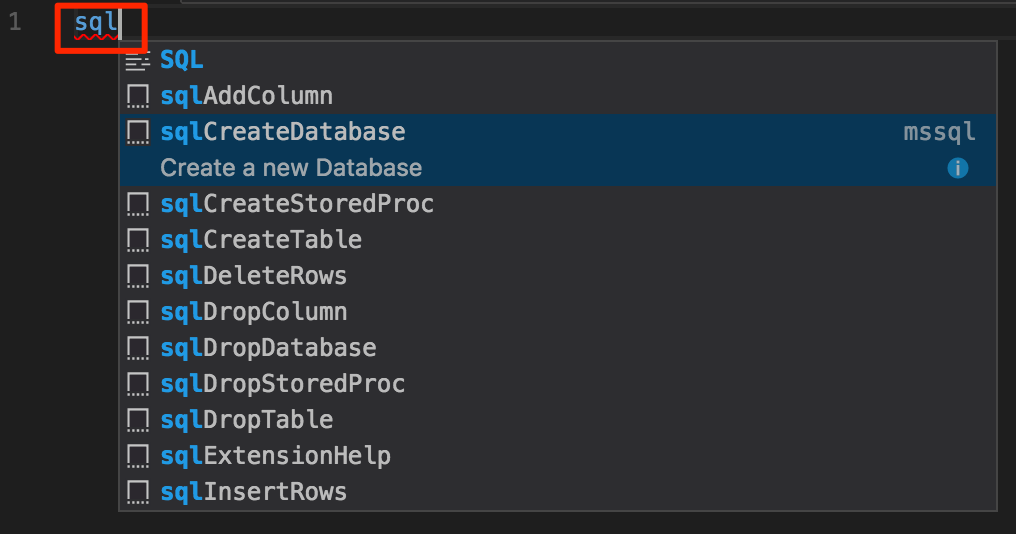
In the editor, type sql to bring up a list of editable code snippets.
-
Select sqlCreateDatabase.
-
In the snippet, type TutorialDB for the database name.
USE master GO IF NOT EXISTS ( SELECT name FROM sys.databases WHERE name = N'TutorialDB' ) CREATE DATABASE [TutorialDB] GO -
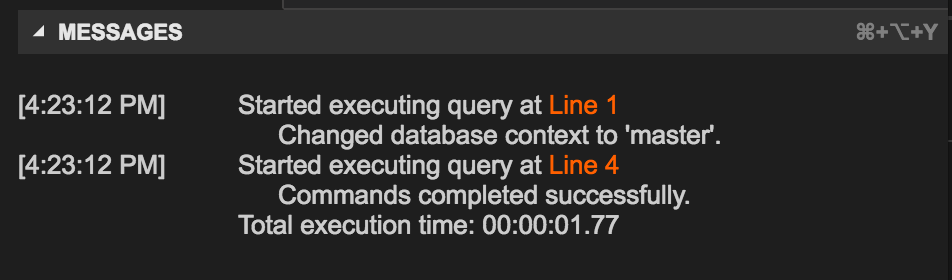
Press ctrl+shift+e to execute the Transact-SQL commands. View the results in the query window.
[!TIP] You can customize shortcut key bindings for the mssql extension commands. See customize shortcuts.


-
Remove the contents of the editor window.
-
Press F1 to display the Command Palette.
-
Type sql in the Command Palette to display the SQL commands or type sqluse for MS SQL:Use Database command.
-
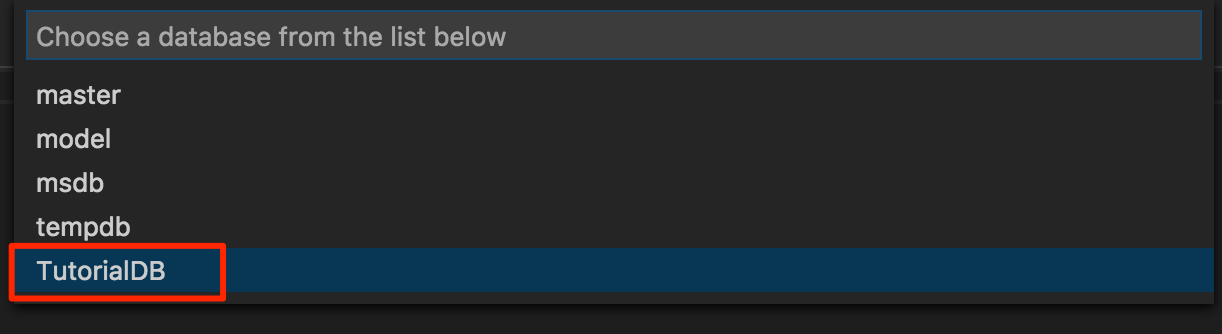
Click MS SQL:Use Database, and select the TutorialDB database. This changes the context to the new database created in the previous section.
-
In the editor, type sql to display the snippets, and then select sqlCreateTable and press enter.
-
In the snippet, type Employees for the table name.
-
Press Tab, and then type dbo for the schema name.
[!NOTE] After adding the snippet, you must type the table and schema names without changing focus away from the VS Code editor.
-
Change the column name for Column1 to Name and Column2 to Location.
-- Create a new table called 'Employees' in schema 'dbo'
-- Drop the table if it already exists
IF OBJECT_ID('dbo.Employees', 'U') IS NOT NULL
DROP TABLE dbo.Employees
GO
-- Create the table in the specified schema
CREATE TABLE dbo.Employees
(
    EmployeeId          INT     NOT NULL    PRIMARY KEY, -- primary key column
    Name        [NVARCHAR](50)  NOT NULL,
    Location    [NVARCHAR](50)  NOT NULL
);
GO
-
Press ctrl+shift+e to create the table.

-
Add the following statements using TSQL IntelliSense to insert four rows and then select all the rows from the Employees table.
-- Insert rows into table 'Employees'
INSERT INTO Employees
    ([EmployeesId],[Name],[Location])
VALUES
    ( 1, N'Jared', N'Australia'),
    ( 2, N'Nikita', N'India'),
    ( 3, N'Tom', N'Germany'),
    ( 4, N'Jake', N'United States')
GO
-- Query the total count of employees
SELECT COUNT(*) as EmployeeCount FROM dbo.Employees;
-- Query all employee information
SELECT e.EmployeesId, e.Name, e.Location
FROM dbo.Employees as e
GO

-
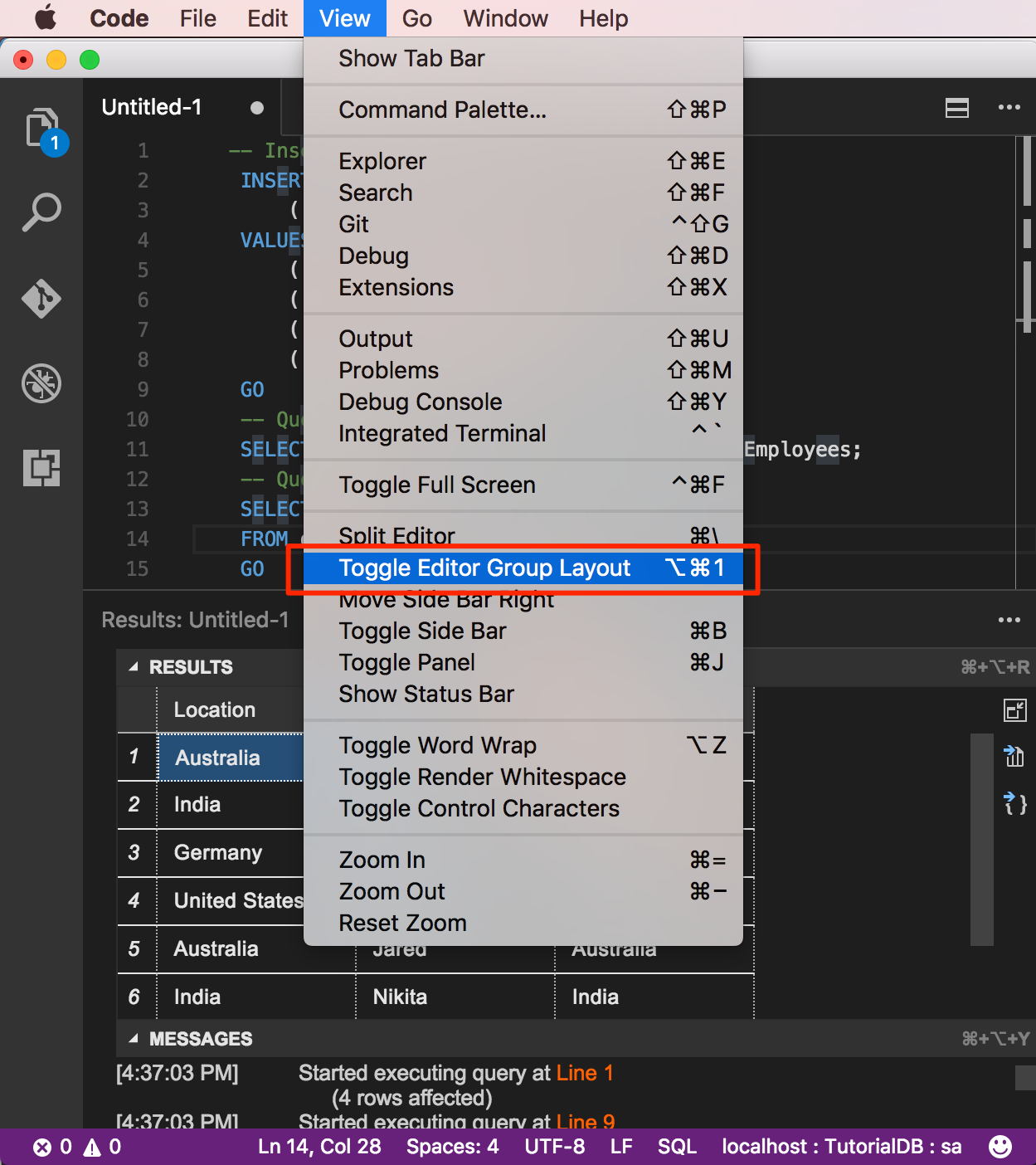
Press ctrl+shift+e to execute the commands. The two result sets display in the Results window.


-
Select VS Code menu: View --> Toggle Editor Group Layout to switch to vertical or horizontal split layout.
-
Click the Results and Messages panel header to collapse and expand the panel.

[!TIP] You can customize the default behavior of the mssql extension. See customize extension options.
-
Click the maximize grid icon on the second result grid to zoom in.

[!NOTE] Maximize icon displays when your TSQL script has two or more result grids.
-
Open the grid context menu with the right mouse button on a grid.

-
Select Save All
-
Open the grid context menu and select Save as JSON to save the result to a .json file.
-
Specify a file name for the json file. For this tutorial, type employees.json.
-
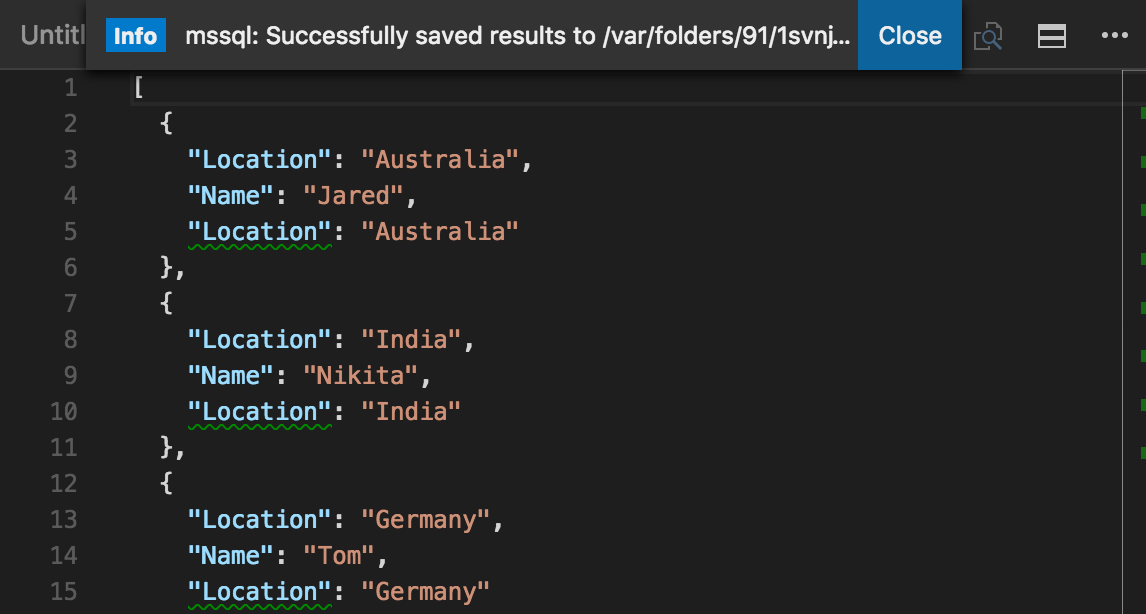
Check the json file is saved and opened in VS Code.


In a real-world scenario, you might create a script that you need to save and run later (either for administration or as part of a larger development project). In this case, you can save the script with a .sql extension.
If you're new to T-SQL, see Tutorial: Writing Transact-SQL Statements and the Transact-SQL Reference (Database Engine).
For more information on using or contributing to the mssql extension, see the mssql extension project wiki.
For more information on using VS Code, see the Visual Studio Code documentation.