Transforming how applications are built and managed in the AI era
Adam Michelson
Group Product Manager, Google Cloud
Anoosh Saboori
Director, Product Management, Google Cloud
AI is massively accelerating the speed at which developers create code. This velocity is shifting the bottleneck from creation to operations, requiring SREs, DevOps, and platform engineers to take that code into production at the necessary speed and scale — all while ensuring it adheres to critical compliance, security, and governance requirements.
To solve this challenge, we announced significant new capabilities and innovations across our portfolio at Google Cloud Next ‘26, including Application Design Center, App Hub/App Topology/App Optimize, and Cloud Hub. These new capabilities transform the entire software lifecycle, helping you turn AI-generated code into enterprise-ready applications that are secure, compliant, and ready for production scale.
In this post, we’ll deep dive into the new capabilities and how you can get started.
Accelerate development velocity with Application Design Center
The Application Design Center enables teams to accelerate the design and deployment of cloud infrastructure, while ensuring architectures adhere to organizational best practices and policies. It helps teams bridge the gap between developers creating applications and the complexities of cloud architecture by providing a library of customizable, pre-built, Google-recommended architecture templates that have security and governance built-in.
1. Based on best-practice architectural templates
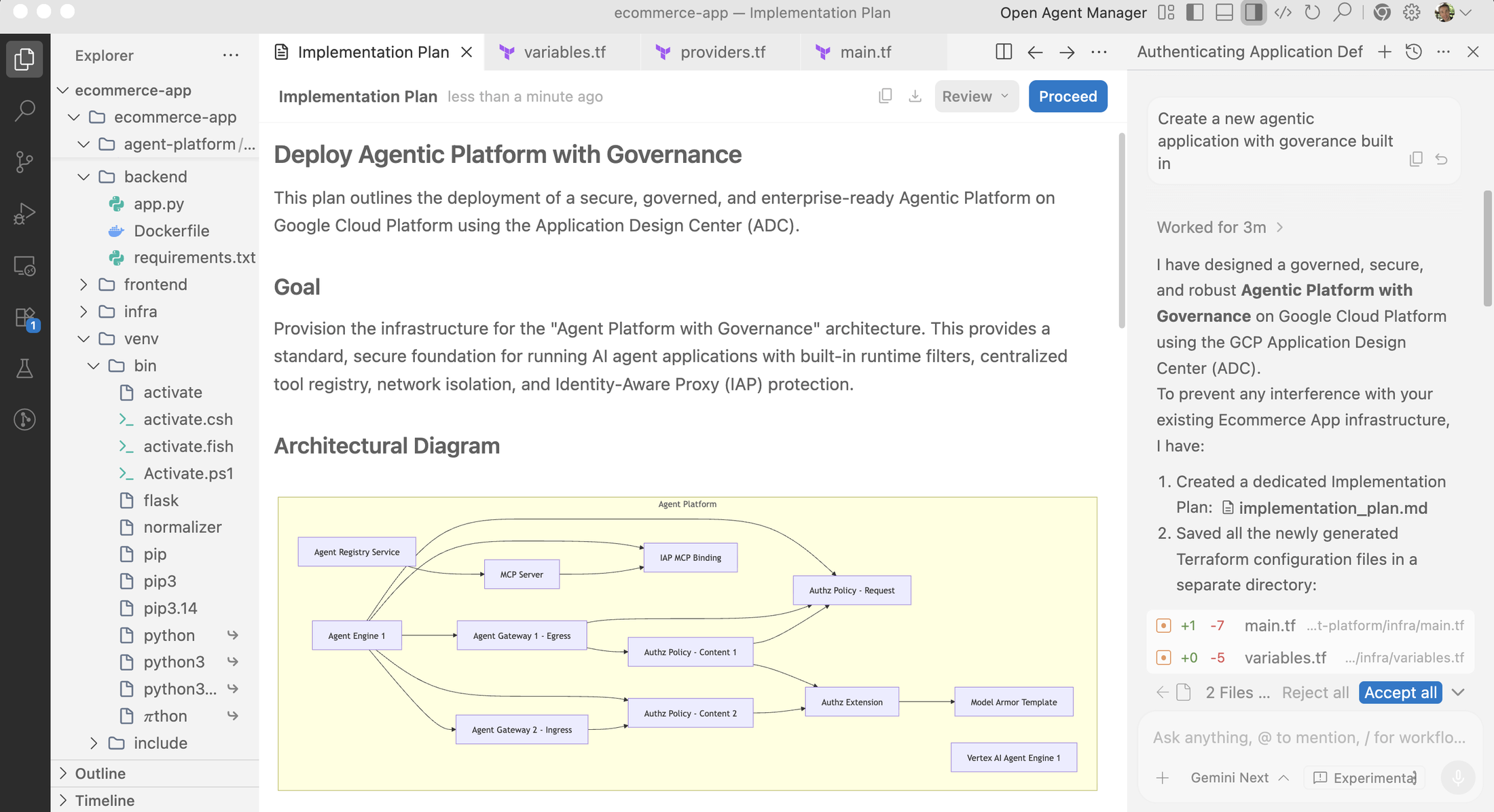
You can develop applications faster with Application Design Center’s growing library of opinionated application best practice architectures. Platform admins can start with pre-defined out-of-the-box architectures, and customize them to curate a collection of Application Templates for their developers to use. This provides developers a trusted, self-service experience they can quickly discover and deploy compliant applications. These templates are also fully integrated with Gemini Cloud Assist, so you can use natural language prompts, including in AI-powered IDEs.
2. Fully deployable infrastructure as code
Application Design Center generates deployable Terraform code from your best-practice architecture templates, including immutable template revisions for auditing architectural changes. And by detecting configuration drift, Application Design Center enables teams to remediate unauthorized changes, or deploy approved updates, ensuring continuous consistency and compliance with organizational guidelines.
(New) Application Design Center now supports custom components to be added to design templates by ingesting existing Terraform configurations. This allows organizations to design using their existing Terraform components. We have also added support to integrate with your preferred CI/CD pipelines, so your teams can follow their existing deployment workflows. In addition, you can now add partner solutions directly into your designs, with support for products from MongoDB, Elasticsearch, Neo4j, and Palo Alto Networks.
3. Understanding business semantics
The Application Design Center treats the "Application" as the central unit of management. By maintaining the application as a core resource, you may define policies or perform observability, troubleshooting, and optimizations on complete applications versus having to manage resources independently.
(New) Application Design Center now pulls-forward security adherence at design time. This includes automated governance as designs created by Gemini Cloud Assist comply with your organization’s policies, and "pre-flight checks" before Applications are deployed. Every application follows organizational guidelines and compliance policies before it ever hits production.
“Enterprise engineering is not solved by AI agents writing more code; it is about the context and standards that define how we build and run software. By embedding our architectural and governance guardrails directly into IDEs and CLIs via Gemini Cloud Assist and the Application Design Center MCP, we are creating a truly agentic developer experience. Platform teams provide the framework, and developers consume it instantly within their workflow. This shifts the focus from producing code to deploying production-ready, compliant solutions from Day 0. The result is faster delivery grounded in enterprise reality.” - Ervis Duraj, Principal Engineer, MediaMarktSaturn Technology
Connect the dots with App Hub and App Topology
Once you have provisioned your infrastructure using the best-practice templates in the Application Design Center, the challenge shifts to maintaining operational consistency and visibility at scale. To do this, your teams need a clear, shared understanding of all your running applications and how they connect. App Hub and App Topology provide this single source of truth.
App Hub acts as a central catalog for all your applications and services. It automatically discovers your cloud infrastructure and organizes it in a way that makes sense for your team. This frees your engineers from having to manually track complex infrastructure. With the new developer insight connect integration, see the lineage of source code and commits that impacted your application, allowing you to see the full picture of your software development lifecycle.
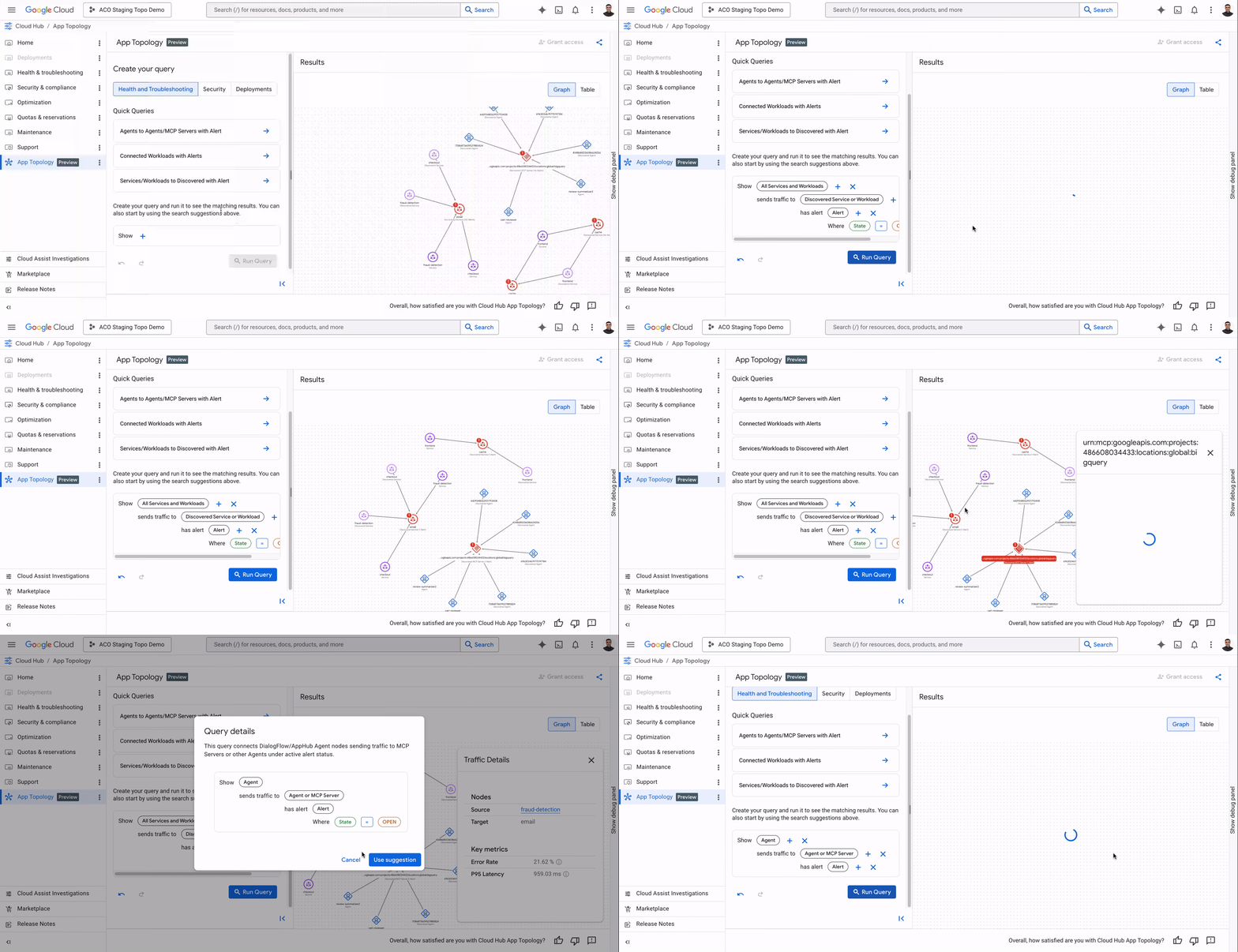
Building on this foundation, App Topology delivers a unified, semantic graph that makes the relationships between your cloud resources visible, understandable, and actionable. This is crucial for rapid troubleshooting and impact analysis, and serves as the foundation for AI workflows to understand how applications are constructed to provide informed, actionable insights.
Streamline app management with Cloud Hub
Once your applications are organized in App Hub and visualized with App Topology, the next step is to manage them effectively. Cloud Hub acts as a unified command center, using AI-driven insights and smart recommendations to help you prioritize and answer the crucial question: "What requires my immediate attention?"
The new Security & Compliance board provides security insights, complemented with Gemini Cloud Assist recommendations for triaging and remediating security findings.
With the new application topology board, you can map service dependencies and recognize how changes impact upstream and downstream components. App topology board now centralizes the connections between application elements and various data domains, making them actionable and clear. The new integration with Gemini Cloud Assist also enables AI-native troubleshooting to resolve issues more quickly.
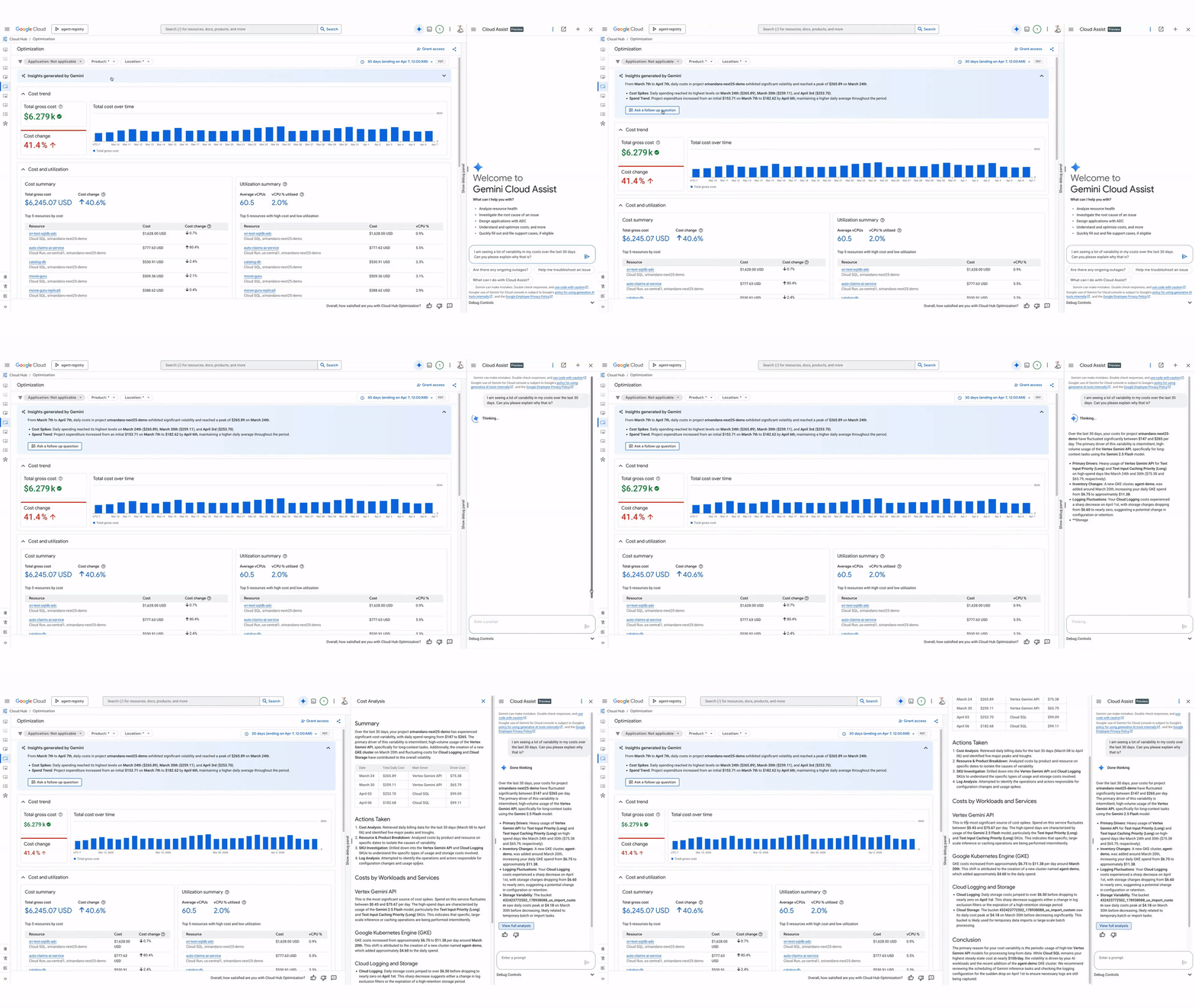
Once your app is up and running, utilize the Cloud Hub Optimization board to get a detailed cost breakdown for application components and their underlying infrastructure, which now supports BigQuery and Networking costs. The board offers high-level insights to help clarify shifts in deployment costs and identify their primary drivers. Furthermore, you can now access cost performance reports for all your applications through the App Optimize APIs.
“Managing a global banking infrastructure often meant struggling with fragmented data and scattered telemetry which impacted our incident response. With Cloud Hub, we have achieved a single pane of glass that cuts through the noise and provides us global visibility into our applications. As we look forward, App Topology will empower our SRE and DevOps teams with cross-domain insights, setting a new standard for reliability and incident response.” – Gerardo Mongelli, Senior Cloud Architect
Google Cloud integrates AI-supported development with AI-assisted intelligent operations and troubleshooting to help your teams accelerate innovation. This approach ensures compliance with organizational standards while building and maintaining secure, high-performing, and reliable applications designed to achieve your business goals.
Get started
To find out more about how Google Cloud can support your organization to transition to the AI era of software delivery, we invite you to try out the Application-centric Google Cloud.
1 and 2. HashiCorp’s The Cloud Complexity Report 2025, 52% of organizations identified the complexity of managing multi/hybrid cloud environments as their biggest infrastructure challenge hindering progress.